Embedding multiplicative understanding through Mastering Number at KS2
How a Preston primary school is transforming pupil confidence, fluency and enjoyment of maths from Reception to KS2 through Mastering Number
10/02/2026
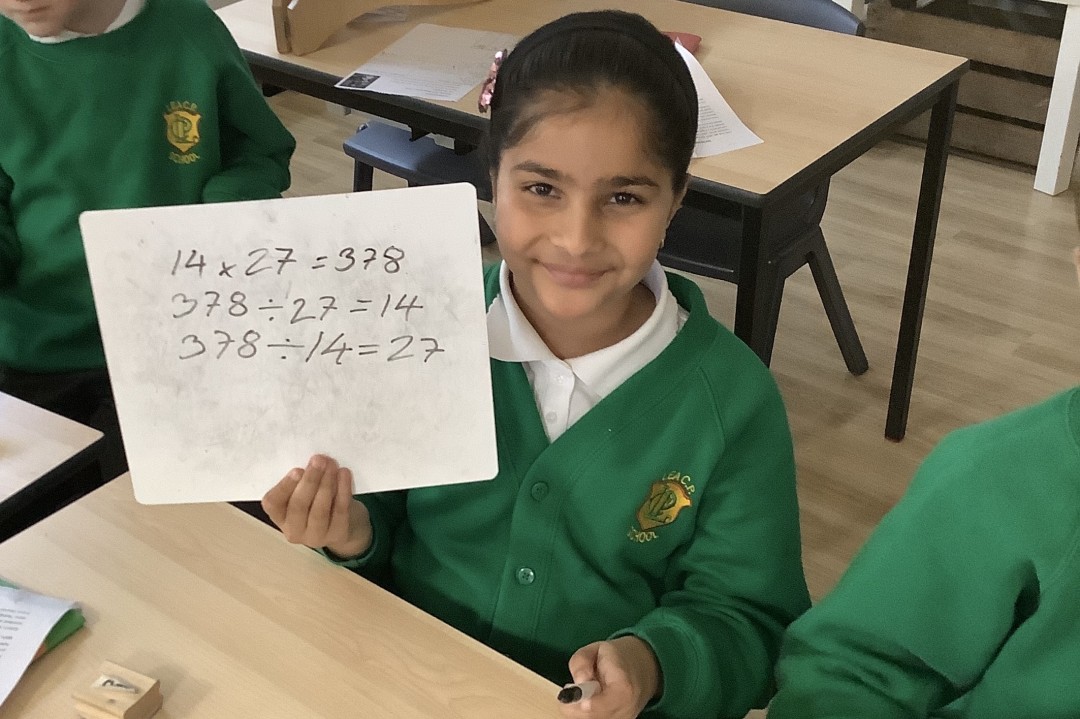
Mastering Number at Reception and KS1 has been adopted in thousands of schools across England, supporting pupils to develop strong number sense. At Lea Community Primary School in Preston, this strong foundation now feeds into the Mastering Number at KS2 Programme, helping pupils deepen their multiplicative understanding.
The school context
Lea Community Primary School is a one-form entry primary school in Preston, Lancashire, with 265 pupils on roll. Around 36% of pupils are eligible for Pupil Premium and 17% speak English as an additional language. The school has been working closely with Abacus Maths Hub to strengthen maths teaching and professional development. Emma Cottam, maths lead and assistant headteacher, explains that the Mastering Number Programme has supported pupils across the school, from developing strong additive number sense in Reception and KS1 to deepening multiplicative understanding in KS2.
The current Year 5 cohort were the first pupils at the school to experience Mastering Number in Reception and KS1 three years ago. This early focus on number composition and structure has been built on through Mastering Number at KS2, which enables pupils in Years 4 and 5 to develop fluency and secure number sense in multiplicative relationships.
Pupil enthusiasm
Staff have found the programme straightforward to implement, while pupil responses have been overwhelmingly positive. ‘The children love Mastering Number, we will often hear a cheer or an excited, ‘Yes!’ when staff say it is time to do our Mastering Number sessions’, Emma says.
Sessions take place straight after lunch, and for many pupils this has become their favourite part of the school day. The consistent routine and short, focused sessions help pupils settle quickly and engage positively with the maths.
Language and gesture
One of the most striking changes staff have noticed is how pupils use mathematical language beyond the sessions themselves. Emma describes seeing Early Years children in continuous provision using stem sentences, a key feature of the Mastering Number approach, to talk about number structure and relationships, such as, ‘5 is made of 3 and 2’ while playing in small world or construction areas.
These early experiences with structured language and representations, used as a tool for thinking, lay the groundwork for later learning. In KS2, stem sentences and gesture continue to help pupils articulate and reason about multiplicative relationships. Using well-chosen gestures alongside talk is a recognised part of the Mastering Number approach. In Mastering Number at KS2, the use of gesture helps to make abstract multiplicative structure more visible and support pupils’ deeper thinking.
Emma recalls seeing children in the KS2 SATs acting out the gestures for square numbers, showing how deeply embedded the learning has become.
Strengthening multiplicative understanding
Through Mastering Number at KS2, pupils have developed a much clearer understanding of multiplication and division and how these ideas connect to other areas of maths.
‘Children are able to see links much more clearly between their times tables and other areas of maths. They are now able to quickly recall their times tables and division facts in maths lessons’.
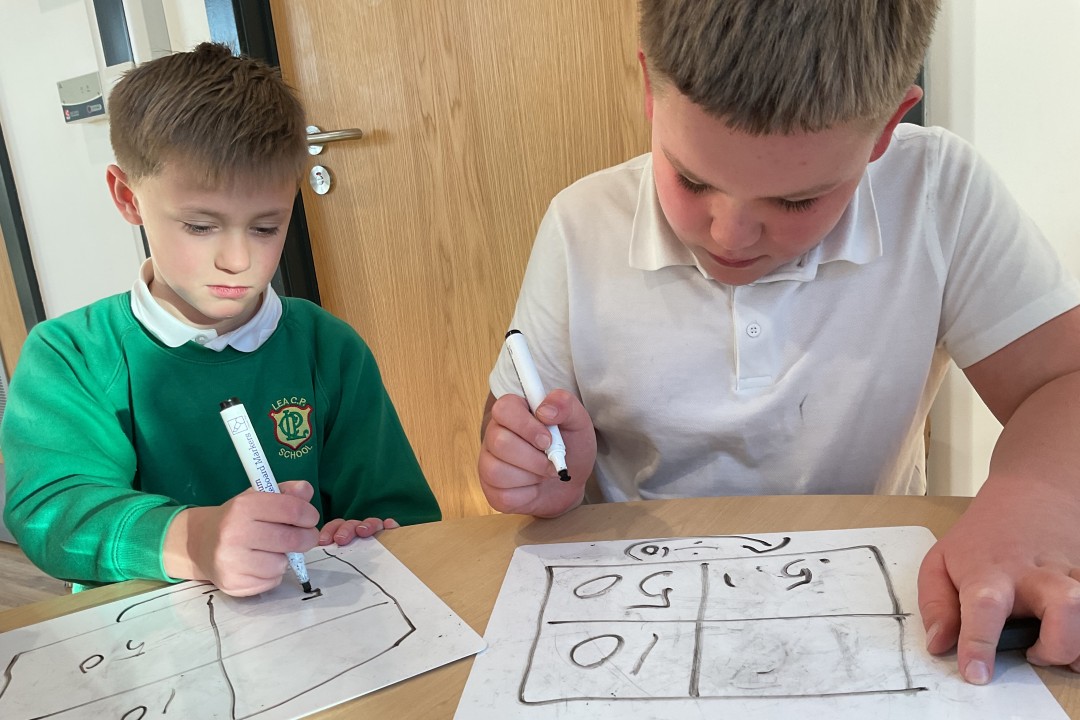
In Years 5 and 6, the ratio tables within Mastering Number at KS2 have had a significant impact. Emma describes how they have transformed pupils’ confidence and understanding of ratio, enabling children to interpret ratio independently rather than relying on memorised procedures.
Beyond preparation for the MTC
Emma is clear that the impact of Mastering Number at KS2 goes well beyond preparing pupils for the Multiplication Tables Check.
‘Children now have a range of strategies to solve multiplicative reasoning questions . They have the times tables knowledge securely embedded to solve different problems, whilst understanding the structure of the multiplication’.
Pupils regularly use representations, such as unitised counters, to model problems and support their thinking. This flexible approach enables them to apply their understanding confidently across a wide range of mathematical contexts such as ratio, fractions and scaling.
Evidence of impact
Since embedding Mastering Number at KS2, the school has seen positive changes in pupils’ performance in the Multiplication Tables Check. Average scores have risen from 16.2 to 21.4, with the number of pupils achieving full marks increasing from three to 20, though, as in all school settings, a range of factors may have contributed to this change.
A message to other schools
For schools considering introducing Mastering Number at KS2, Emma’s advice is simple:
‘Do it! The programme is easy to follow and has such an impact on all children. Our children are true mathematicians as a result of Mastering Number.’
Mastering Number at KS2 is open to all schools also participating in a Teaching for Mastery Work Group.
Support multiplicative reasoning in KS2
Find out how you can get involved in Mastering Number at KS2 to help pupils build fluency, multiplicative number sense and confidence through daily practice and focused routines
Learn more