From KS2 to GCSE: developing fluency in multiplicative reasoning at KS3
Natalie Bain explains how Developing Fluency in Multiplicative Reasoning at KS3 helps teachers build on students’ existing understanding and lay the foundations for future learning
23/09/2026
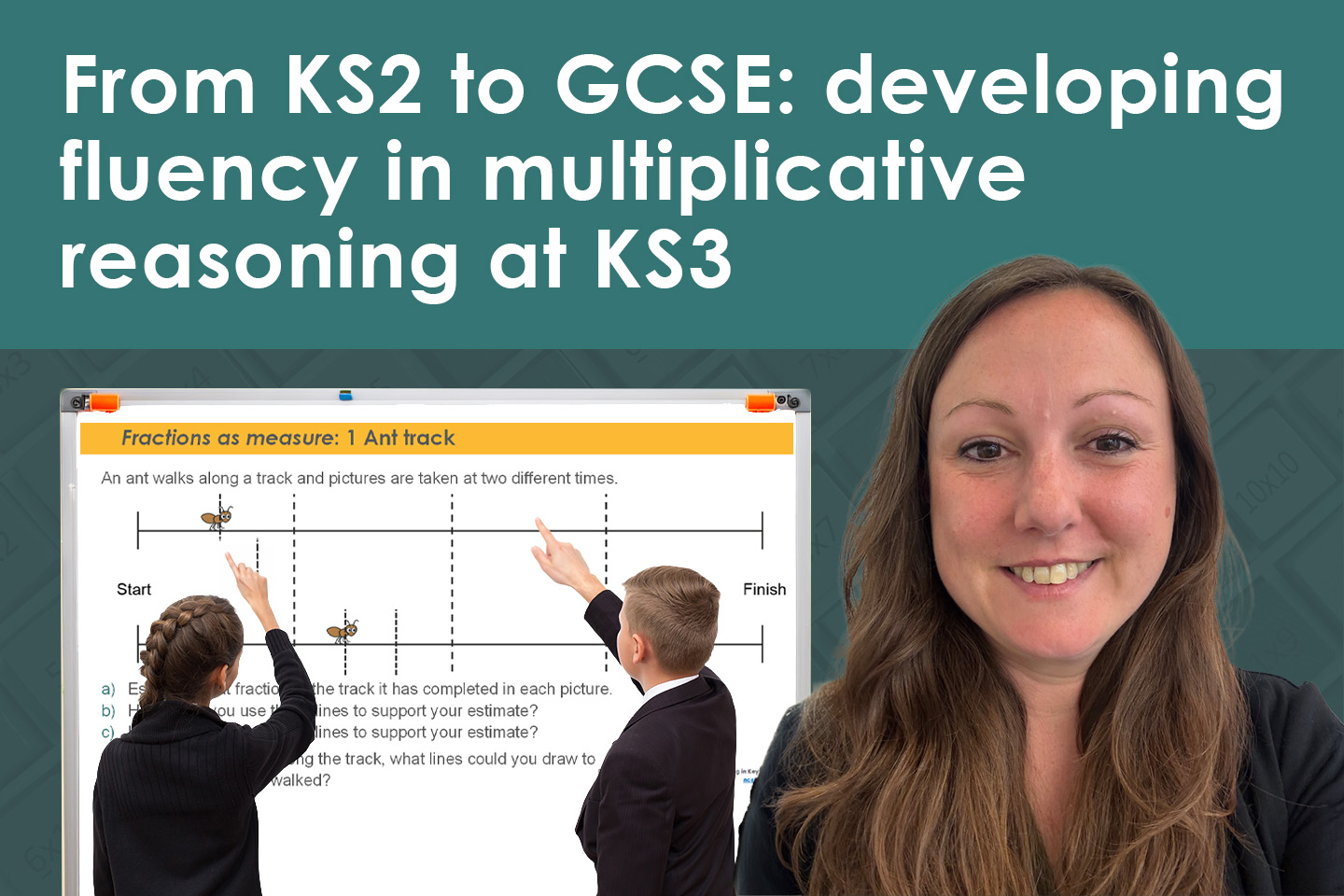
Natalie Bain has worked with Jurassic Maths Hub for more than ten years, first as a participant in professional development and later as a Mastery Specialist and Professional Development Lead. While working as a director of maths for a Dorset-based multi-academy trust, she also began leading Work Groups in Developing Fluency with Multiplicative Reasoning at KS3 for Jurassic Maths Hub.
We spoke to Natalie about how this professional development opportunity for secondary teachers can ultimately help students become more confident and adaptable mathematicians in an area of the curriculum fundamental to success in KS4.
What is Developing Fluency with Multiplicative Reasoning at KS3 trying to achieve?
It helps teachers understand how to enable their students to develop a deeper understanding of multiplicative relationships, rather than relying only on procedures they have been taught to follow.
We start by looking at how students experienced multiplication at KS2, through representations such as arrays, and what they actually understand about multiplication. Can they do more than get the right answer? Can they use related facts confidently and explain their reasoning?
We then look at other areas of the curriculum, including fractions, percentages and division, and introduce representations such as double number lines and ratio tables. These have applications across so much of secondary maths. Multiplicative reasoning links to ratio and proportion, fractions and percentages, but also to similarity, rates of change, speed, distance and time, and trigonometry, which is a significant proportion of the maths they will encounter at KS4.
Participants tell us that they have noticed a real difference in their students in terms of how they articulate their ideas, their confidence with maths and their ability to choose the most efficient strategy.
How can developing fluency in multiplicative reasoning support students?
I think it takes students from simply using a procedure to calculate an answer to seeing the mathematical relationship and being able to identify the most efficient method. Instead of relying on a memorised formula triangle for speed, distance and time, for example, they can represent the problem on a double number line and see the relationships involved.
Tools such as ratio tables apply so easily across different parts of the curriculum that it is almost as though the amount of maths students have to learn is reduced.
They have ways of thinking and representations they can draw on in different contexts, so they can identify different solutions rather than having to remember one procedure or formula they’ve learned.
It helps develop that depth of understanding at KS3 so that, when students encounter exam questions at KS4, they are more confident about approaching them. If they can read a question and see the mathematical structure underneath it, they are better equipped to decide what they need to do.
With my Year 11 group, we looked at exam questions from across the curriculum and asked, ‘How could you use a ratio table to answer this?’ They became really good at recognising where they could use it across different areas of maths.
What does the professional development involve?
It involves three full days of local professional development across the year, with each school nominating up to two KS3 teachers to take part. One Work Group focuses on Year 7 content. A second focuses on Year 8 and is for schools that have previously taken part in a Year 7 Work Group.
The resources are really high-quality and are directly applicable to teaching KS3 maths, so there are plenty of opportunities for participants to use them in their lessons. They complete activities between the face-to-face sessions, but these are based on teaching the participants would be doing anyway. The additional element is reflecting on their teaching and how the resources supported the lesson and helped students in their confidence and understanding.
There is a real value for teachers in having three days away from the classroom, with the headspace to learn, think and work alongside other teachers.
How do the materials support teachers?
Participants receive six slide decks containing resources that have been carefully sequenced to develop students’ mathematical thinking. Some teachers build them into sequences of lessons, while others select individual questions or activities to use within their existing lessons.
One activity, for example, asks students: ‘True or false: a fraction is a number?’
Our participants found the responses really fascinating because they offered an insight into students’ existing understanding. We could then unpick that and consider how to deepen students’ understanding of fractions as numbers as well as operators.
What does the programme offer the wider maths department?
Sharing the learning is part of the programme, so there is an expectation that what happens during those three days is taken back to the department and shared across the team. The materials can be used to support collaborative planning and departmental discussions about teaching, so the benefit is not limited to the individual teachers attending.
From my experience as a director of maths, there is also something really valuable about giving teachers access to high-quality professional development and the chance to work with like-minded people. It can get staff excited about the maths again, and they bring that enthusiasm and learning back into their departments.
Why would you recommend the programme to teachers and maths leaders?
It improves outcomes for students, but there is a whole other side to it in terms of teacher development, job satisfaction and retention. Good teachers really value these professional development opportunities. As a leader, having teachers take part gives you a consistent, high-quality approach to developing teaching through mastery, informed by the latest evidence about what supports students’ learning.
Genuinely, this programme is amazing. Maths Hubs Work Groups are fantastic opportunities not only to develop the pedagogy, but to develop your staff for free. It's a brilliant way to keep your staff happy and successful with their students. What more could you want than that?
Apply now for 2026/27 Work Groups
Give your students a secure start in KS3 with this fully-funded CPD programme that builds understanding and lays firm foundations for future maths learning.
Find your hub