‘They’ll give it a go’: how teaching for mastery helped one SEMH school change teacher and student mindsets
A head of maths explains how lesson videos helped her team explore teaching for mastery approaches in a specialist setting
14/10/2026
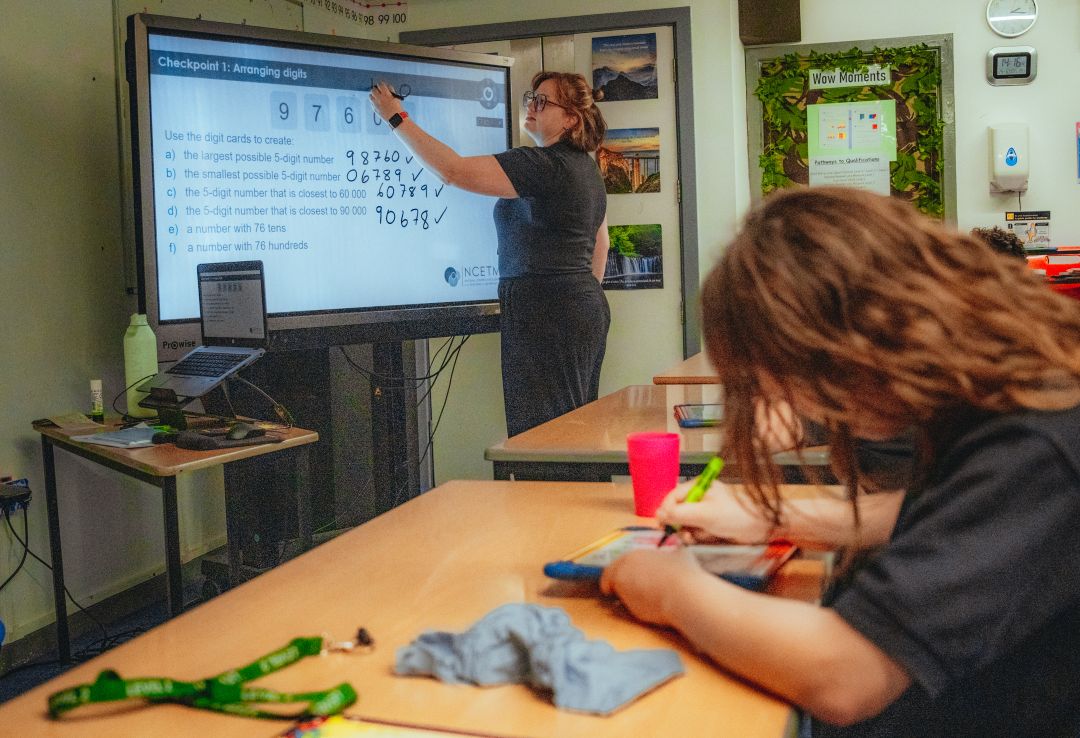
Hayley James is head of maths at Oak Bank School, a secondary Social, Emotional and Mental Health (SEMH) special school in Leighton Buzzard. For several years, she has been developing a teaching for mastery approach at the school with support from Enigma Maths Hub. To share this work with colleagues, Hayley has been using carefully selected lesson videos to open up professional discussion and demonstrate how teaching for mastery can work in their setting.
Oak Bank School supports students in Years 5 to 13 whose primary need is social, emotional and mental health difficulties. Levels of disadvantage are high, with around three in five students eligible for free school meals. Many also face overlapping challenges, including disrupted education, poor attendance and difficult family or social circumstances. They may arrive in maths lessons with gaps in prior learning, low confidence, anxiety about making mistakes or a strong reluctance to take part.
When Hayley James joined the maths department, a search for ‘free’ professional development opportunities led her to Enigma Maths Hub. She first became involved in the Teaching for Mastery Programme, before developing her own practice further through the Secondary Mastery Specialist Programme.
Looking back, she can see how that professional development changed not only her own practice, but the way her department thought about maths and what students could achieve.
Making mathematics accessible
Most students at Oak Bank School have been excluded from mainstream education and have experienced considerable difficulties at school, making engagement with learning particularly challenging. When Hayley first began exploring teaching for mastery, some colleagues questioned whether an approach developed largely in mainstream schools would work in their setting, but Hayley saw it differently.
‘Teaching for mastery is the most visual way of doing maths. It’s an approach that reveals the complete structures of maths. I felt this would be a way our students would be able to access it.’
For Hayley, that emphasis on making mathematical structures visible was particularly important. Students were not simply learning procedures. They were being given opportunities to explore ideas, make connections and discuss their thinking. Rather than focusing solely on answers, lessons increasingly focused on discussion, reasoning and helping students understand why maths works. Mini whiteboards became an important part of lessons, giving every student an accessible way to participate and express their ideas.
As Hayley’s confidence in teaching using a mastery approach grew, she began to consider how it could become part of the department’s shared practice, rather than something confined to her own classroom.
Opening up practice through video
One idea from the Secondary Mastery Specialist Programme proved especially influential. Another participant in the group had shared how they used short video clips of a lesson to support professional discussion within their department. Seeing the lesson in action, and the learning taking place, immediately engaged colleagues, allowing them to share their own expertise and reflect together on the teaching. Hayley decided to try something similar with her own team.
Because students cannot be filmed, the recordings focus on the teacher, the board and examples of students' work. Shared during department meetings, they provided a starting point for discussion about language, questioning and representation. Importantly, the clips were never intended to showcase perfect lessons. Hayley explains, 'It was more focused on opening up and asking, “Can you tell me what I could have done better?”'
That approach encouraged colleagues to contribute their own expertise. Discussions often centred on practical classroom decisions and how best to help students understand mathematical ideas. Hayley explains, ‘I think what happened was colleagues felt heard. They felt they had a voice, and that they had something to bring to the table.’
One conversation about teaching negative numbers led to a discussion about pattern spotting and how students could be helped to recognise mathematical structure. Another focused on the language used during explanations and questioning. Over time, these discussions began to influence practice across the department. Colleagues drew on ideas from the clips, adapted them for their own classes and became more willing to open up their lessons to one another. Teaching for mastery was no longer seen simply as Hayley’s approach, but as something the team could explore, question and develop together.
Seeing students respond differently
As teachers began exploring the approach collaboratively, they also began to notice changes in students' responses to maths. In a setting where emotional regulation can be a daily challenge, Hayley says lessons became calmer and students spent longer focused on learning.
‘We’ve seen clear evidence in my lessons that the way students interact with maths has changed. Maths hasn't been a trigger for these students, which it used to be.’
For colleagues who had initially been unsure whether teaching for mastery would work in their setting, seeing those changes in their own classrooms proved persuasive and prompted staff to reconsider what their students might be capable of achieving.
‘We've gone from activities such as games to develop their fluency to full 40-minute lessons where students are now engaging in GCSE content and are keen to sit the exams, which just didn't happen five years ago.’
Hayley is careful not to present this as a story of abandoning approaches that had previously helped students engage, and activities designed to support mathematical fluency remain important. What did change was the department's confidence that students could access richer mathematical thinking and more ambitious content.
That confidence was also reflected in students themselves. Hayley explains, 'Three years ago they would have looked at the paper, closed the booklet and said, “I'm not going to try”. Now, they'll look at that booklet and say, “I'll give it a go.” We now enter every student for GCSE, whereas before there might just have been two or three that we felt could manage.’
While many students will continue to work towards a Grade 4 in GCSE maths, Hayley wants every young person to leave Oak Bank School believing that maths is a subject they can participate in, continue to study and succeed in.
Continuing the journey
Hayley continues to engage with Enigma Maths Hub and sees professional development as an important part of maintaining momentum in her own practice. ‘It keeps me on my toes,’ she explains, ‘There is always a new idea or different approach that just keeps things fresh.’
More recently, Hayley is looking forward to leading a Regional Special Schools Teaching for Mastery Community for her hub which will bring together maths teachers from special schools, and she is keen to share her own experiences in teaching for mastery within an SEMH setting.
The NCETM’s Essence of Mathematics Teaching for Mastery identifies the belief that ‘everyone can learn and enjoy mathematics’ as an underpinning principle of the approach. Hayley has seen this borne out in practice, as students who might once have refused to participate in maths lessons are now more willing to engage, persevere and see themselves as capable of succeeding.
Teaching maths in a specialist setting or alternative provision?
Talk to your local Maths Hub to connect with maths teachers in similar settings and find out how teaching for mastery can support both teachers and students.
Find your hub