Fractions | Year 5
National Curriculum resources for Fractions – Year 5
National Curriculum resources for Fractions – Year 5
National Curriculum resources for Statistics – Year 3
National Curriculum resources for Measurement – Year 6
Spine 3: Fractions – Topic 3.10
National Curriculum resources for Number – Key Stage 3
Unit 3 – 2 weeks
Unit 7 – 6 weeks
Unit 10 – 2 weeks
National Curriculum resources for Geometry and Measures – Key Stage 3
National Curriculum resources for Fractions – Year 6
Unit 6 – 2 weeks

Core concept 6.2 covers how the formulae for perimeter, area and volume are derived and connected, and the importance of reasoning mathematically to solve a range of problems.
National Curriculum resources for Multiplication and Division – Year 6
In this approach, all pupils in the class are taught together, following a carefully-sequenced two-year rolling programme
National Curriculum resources for Addition and Subtraction – Year 6

Four steps to help you plan and teach percentage change
Teachers who want to achieve or enhance maths leadership accreditations can now apply for two separate professional development programmes

Applications now open for two separate professional development programmes

Whether you’re a new teacher, or coming back to begin another year, we are here to support you with all your maths CPD this year and beyond

Undergraduate and master’s students interested in teaching shortage subjects, including maths, can now apply for fully-funded, paid Teaching Internships taking place this summer.

An article from our Director, Charlie Stripp

At a small, rural primary school, pupils in mixed-age classes benefit from teaching for mastery approaches

What do your Year 7s already know and understand? How can you find out? And how can you move their understanding forward in Year 7?

We visit a school using the materials to structure INSET and department time for professional development

Maths competitions can be a great way to broaden students’ mathematical horizon – get the dates in the school diary early!

Addressing two years of disrupted schooling, Checkpoints activities will help you to formatively assess understanding of key topics
Spine 2: Multiplication and Division – Topic 2.30
An article from our Director, Charlie Stripp

Our latest NCETM newsletter is now available
Our latest NCETM newsletter is now available
A secure understanding of Key Stage 2 maths is crucial for new Year 7s to progress at secondary school
Support for maths learning and teaching during school closures, Primary and Secondary Mastery Specialist recruitment, and other opportunities for 2020/21

We visited USP College in Essex to find out their six steps to effective enrolment in Core Maths
National Curriculum resources for Fractions – Year 4

Bringing a teaching for mastery lens to Oak’s financial education resources across the primary and secondary phases

The Trends in International Mathematics and Science Study (TIMSS) confirms that England has maintained its high global performance in mathematics

Representatives from England’s three main exam boards share their thoughts
National Curriculum resources for Geometry - properties of shapes – Year 5
Core concept 6.4 explores: triangles of given lengths; a perpendicular bisector of a line segment; a perpendicular to a given line through a given point; an angle bisector.

How one school employed a primary teacher to help introduce mastery
An article by Hande Kiamil, Head of Maths at Mill Hill County High School, in the London Borough of Barnet

How partnership with its local Maths Hub is improving outcomes for pupils at Sycamore Trust in Greater Manchester
Video lessons on linking fractions, decimals and percentages for children in Years 5 and 6

One North Yorkshire primary school has made teaching for mastery work in four classes which span seven year groups
Spine 2: Multiplication and Division – Topic 2.16

An article from our Director, Charlie Stripp

Hear from a Mastery Specialist as he shares the impact of this fully-funded programme on post-16 maths teaching at Andover College

A head of maths and Maths Hub Lead talks about the benefits of the qualification

Two primary schools explain how they use textbook schemes to support teaching for mastery
An article from our Director, Charlie Stripp
National Curriculum resources for Statistics – Year 2
National Curriculum resources for Statistics – Year 4
National Curriculum resources for Addition and Subtraction – Year 3

Core concept 3.1 explores fractions, percentages, ratio and proportion (direct and inverse) as contexts in which multiplicative relationships are used.

A London school models one possible way to make the transition
National Curriculum resources for Algebra – Key Stage 3
An article from our Director, Charlie Stripp
An article from our Director, Charlie Stripp
Guidance for secondary schools – updated November 2020

A deputy head talks about using active learning in maths across Key Stages 1 and 2, and the benefits this has had for children after a long period of home learning

Looking for and finding patterns helps children notice and understand mathematical relationships

How Intensive support helped one secondary school to improve GCSE Maths results by 20 percentage points

The NCETM’s Primary Director attends investiture performed by Princess Anne
Find out more about current NCETM team members with their areas of responsibility. If you want to get in touch with someone at the NCETM, email info@ncetm.org.uk with full details of your query and we will direct it to the right person
National Curriculum resources for Ratio and Proportion – Year 6
National Curriculum resources for Measurement – Year 5
National Curriculum resources for Measurement – Year 4
Theme 6 comprises four core concepts: geometrical properties; perimeter, area and volume; transforming shapes; constructions.
Two examples of multi-academy trusts (MATs) successfully engaging with Maths Hubs and seeing maths performance rise
National Curriculum resources for Number and Place Value – Year 4
National Curriculum resources for Ratio and Proportion and Rates of Change – KS3
National Curriculum resources for Geometry - properties of shapes – Year 3

Diagnostic maths activities to help teachers develop their assessment of students' prior learning for KS3
National Curriculum resources for Measurement – Year 3
Unit 11 – 1 week
National Curriculum resources for Statistics – Year 6
National Curriculum resources for Multiplication and Division – Year 2

The AMSP's Tom Button looks at which calculations A level students should be doing on a calculator
Unit 4 – 2 weeks

The NCETM Director and the Director for Evaluation and Impact reflect on the latest international maths comparison tests and how this informs developments in the NCETM and the Maths Hubs Network

Nicola Trubridge, the NCETM’s Director for Secondary Mathematics, reflects on the latest PISA findings and what they might mean as the maths education community prepares for a new maths national curriculum
Examples of three of the 15 lessons contained within the Teaching Units

Leanne Casey tells us about her experiences of becoming a Mastery Specialist
Charlie Stripp explores the gender gap in maths attainment between boys and girls, and why it matters for girls’ future opportunities, social equity and the nation’s overall potential
An article from our Director, Charlie Stripp
Theme 3 comprises two core concepts: understanding multiplicative relationships; trigonometry.
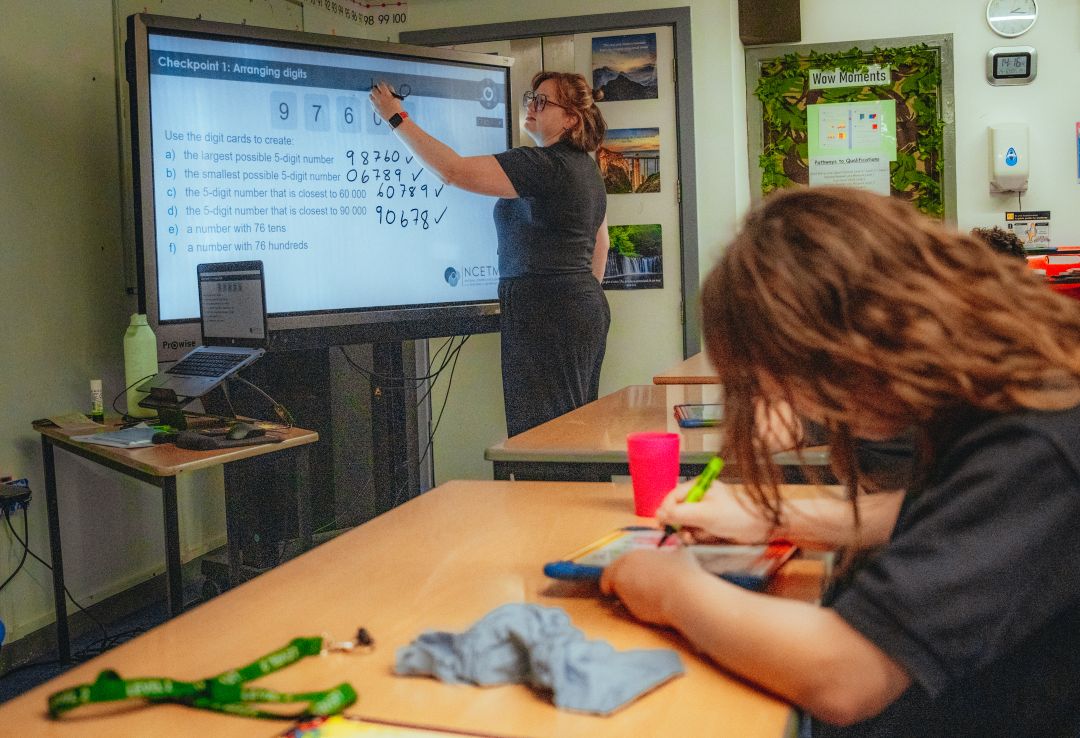
A head of maths explains how lesson videos helped her team explore teaching for mastery approaches in a specialist setting

‘Is there a relationship between maths, gender and learning? How might it be characterised?’ Dr Eugenia Cheng shares her ideas.
Copyright information
An article from our Director, Charlie Stripp

A Year 6 teacher talks about the difficulty of engagement in remote learning in an area with a low socio-economic profile
An archive of all Secondary Round-ups and Magazines

What role can trust leaders play in supporting maths teachers to flourish professionally?
Answers to the questions most frequently asked

What maths to teach for the rest of 2020/21

Our latest Secondary Round-up is now available

Article by Jenny Laurie, Deputy Head at The St Marylebone CE School, London

A look at two of this year’s KS2 SATs questions, analysing the demands made on pupils and the mathematical thinking required
National Curriculum resources for Geometry - properties of shapes – Year 6
Four steps to help you plan and teach percentage change
Teachers who want to achieve or enhance maths leadership accreditations can now apply for two separate professional development programmes
Applications now open for two separate professional development programmes
Whether you’re a new teacher, or coming back to begin another year, we are here to support you with all your maths CPD this year and beyond
Undergraduate and master’s students interested in teaching shortage subjects, including maths, can now apply for fully-funded, paid Teaching Internships taking place this summer.
An article from our Director, Charlie Stripp
What do your Year 7s already know and understand? How can you find out? And how can you move their understanding forward in Year 7?
We visit a school using the materials to structure INSET and department time for professional development
Maths competitions can be a great way to broaden students’ mathematical horizon – get the dates in the school diary early!
Addressing two years of disrupted schooling, Checkpoints activities will help you to formatively assess understanding of key topics
An article from our Director, Charlie Stripp
Our latest NCETM newsletter is now available
Our latest NCETM newsletter is now available
A secure understanding of Key Stage 2 maths is crucial for new Year 7s to progress at secondary school
Support for maths learning and teaching during school closures, Primary and Secondary Mastery Specialist recruitment, and other opportunities for 2020/21
We visited USP College in Essex to find out their six steps to effective enrolment in Core Maths
Bringing a teaching for mastery lens to Oak’s financial education resources across the primary and secondary phases
The Trends in International Mathematics and Science Study (TIMSS) confirms that England has maintained its high global performance in mathematics
Representatives from England’s three main exam boards share their thoughts
How one school employed a primary teacher to help introduce mastery
An article by Hande Kiamil, Head of Maths at Mill Hill County High School, in the London Borough of Barnet
How partnership with its local Maths Hub is improving outcomes for pupils at Sycamore Trust in Greater Manchester
An article from our Director, Charlie Stripp
Hear from a Mastery Specialist as he shares the impact of this fully-funded programme on post-16 maths teaching at Andover College
A head of maths and Maths Hub Lead talks about the benefits of the qualification
Two primary schools explain how they use textbook schemes to support teaching for mastery
An article from our Director, Charlie Stripp
An article from our Director, Charlie Stripp
An article from our Director, Charlie Stripp
A deputy head talks about using active learning in maths across Key Stages 1 and 2, and the benefits this has had for children after a long period of home learning
How Intensive support helped one secondary school to improve GCSE Maths results by 20 percentage points
The NCETM’s Primary Director attends investiture performed by Princess Anne
Two examples of multi-academy trusts (MATs) successfully engaging with Maths Hubs and seeing maths performance rise
The AMSP's Tom Button looks at which calculations A level students should be doing on a calculator
The NCETM Director and the Director for Evaluation and Impact reflect on the latest international maths comparison tests and how this informs developments in the NCETM and the Maths Hubs Network
Nicola Trubridge, the NCETM’s Director for Secondary Mathematics, reflects on the latest PISA findings and what they might mean as the maths education community prepares for a new maths national curriculum
Leanne Casey tells us about her experiences of becoming a Mastery Specialist
Charlie Stripp explores the gender gap in maths attainment between boys and girls, and why it matters for girls’ future opportunities, social equity and the nation’s overall potential
An article from our Director, Charlie Stripp
A head of maths explains how lesson videos helped her team explore teaching for mastery approaches in a specialist setting
‘Is there a relationship between maths, gender and learning? How might it be characterised?’ Dr Eugenia Cheng shares her ideas.
An article from our Director, Charlie Stripp
A Year 6 teacher talks about the difficulty of engagement in remote learning in an area with a low socio-economic profile
What role can trust leaders play in supporting maths teachers to flourish professionally?
Our latest Secondary Round-up is now available
Article by Jenny Laurie, Deputy Head at The St Marylebone CE School, London
A look at two of this year’s KS2 SATs questions, analysing the demands made on pupils and the mathematical thinking required
Spine 3: Fractions – Topic 3.10
Unit 3 – 2 weeks
Unit 7 – 6 weeks
Unit 10 – 2 weeks
Unit 6 – 2 weeks
Core concept 6.2 covers how the formulae for perimeter, area and volume are derived and connected, and the importance of reasoning mathematically to solve a range of problems.
At a small, rural primary school, pupils in mixed-age classes benefit from teaching for mastery approaches
Spine 2: Multiplication and Division – Topic 2.30
Core concept 6.4 explores: triangles of given lengths; a perpendicular bisector of a line segment; a perpendicular to a given line through a given point; an angle bisector.
Video lessons on linking fractions, decimals and percentages for children in Years 5 and 6
One North Yorkshire primary school has made teaching for mastery work in four classes which span seven year groups
Spine 2: Multiplication and Division – Topic 2.16
Core concept 3.1 explores fractions, percentages, ratio and proportion (direct and inverse) as contexts in which multiplicative relationships are used.
A London school models one possible way to make the transition
Guidance for secondary schools – updated November 2020
Looking for and finding patterns helps children notice and understand mathematical relationships
Theme 6 comprises four core concepts: geometrical properties; perimeter, area and volume; transforming shapes; constructions.
Diagnostic maths activities to help teachers develop their assessment of students' prior learning for KS3
Unit 11 – 1 week
Unit 4 – 2 weeks
Theme 3 comprises two core concepts: understanding multiplicative relationships; trigonometry.
What maths to teach for the rest of 2020/21