
John’s 40-40-40 challenge: mission accomplished!
NCETM Director for System Leadership, John Westwell, has completed a parkrun in every Maths Hub region in England
NCETM Director for System Leadership, John Westwell, has completed a parkrun in every Maths Hub region in England

Seven suggested resources and activities to help you prepare your students for exams

Hear how this programme develops teaching expertise, strengthens departments and supports coherent maths practice across schools and trusts

When should Year 6 and 7 teachers get the calculators out? And how might they use them?

How groups of primary schools have been introducing a twin-track approach to times-tables learning

Hear from maths teacher Adam Creen on what it’s like to lead A level professional development and subject communities for North-East Hants and Surrey Maths Hub
A range of professional development and lesson materials

Article by Jayne Webster, who teaches maths at Denbigh School in Milton Keynes

How smaller CPD projects refine, innovate and improve the Maths Hubs Programme and give teachers an opportunity to pursue special interests
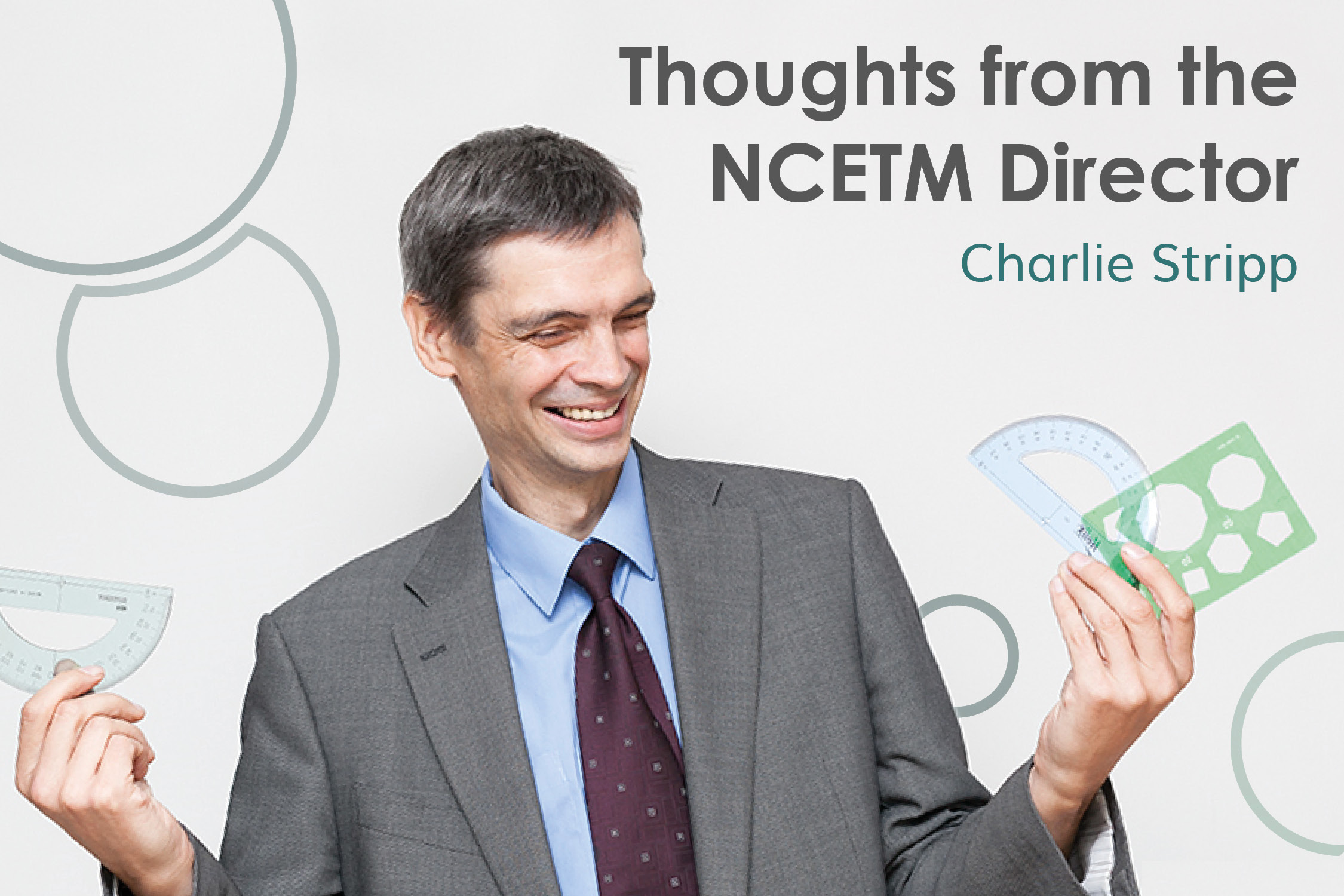
Charlie Stripp reflects on ten years of the Maths Hubs Programme
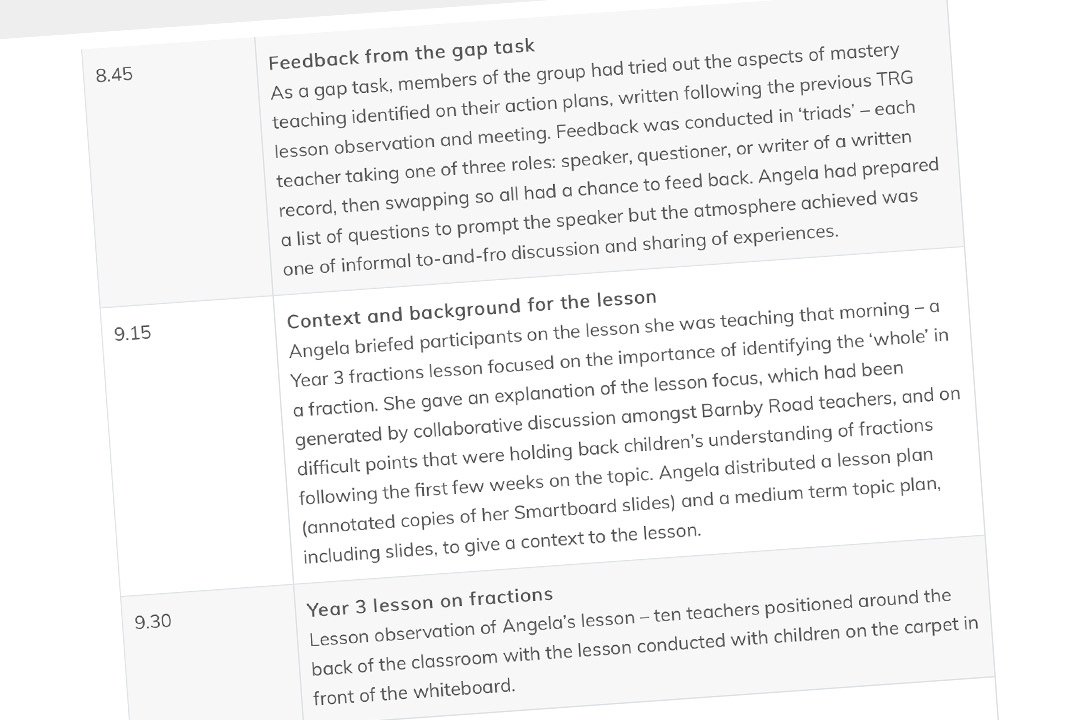
Green shoots of Teacher Research Groups (TRGs) are slowly spreading their fronds of mastery exploration across the country

A visit to two lessons at Tomlinscote School in Frimley, Surrey
An article from our Director, Charlie Stripp

There’s a range of ways for teachers and schools to engage with their local Maths Hub

Hear from a maths teacher and podcaster who leads a range of projects

Check out our podcast, with nearly 80 episodes discussing maths teaching in all phases, featuring a wide range of guests

A wide-ranging conversation covering engagement, curriculum, classroom culture, and preparing students for maths beyond school
An overview of how the NCETM is working with the Education Endowment Foundation (EEF) in 2025/26

Core concept 6.2 covers how the formulae for perimeter, area and volume are derived and connected, and the importance of reasoning mathematically to solve a range of problems.
National Curriculum resources for Probability and Statistics – Key Stage 3

Core concept 10.3 explores probability in more depth, including a variety of representations, and offers a range of contexts to ensure students can find probabilities of both single and combined events
Information for schools, including FAQs
Information for schools, including FAQs
The full range of CPD opportunities available through Maths Hubs has been published
National Curriculum resources for Statistics – Year 4

At Trinity Academy in Halifax all teachers are now using place value counters with students across the ability range
National Curriculum resources for Number and Place Value – Year 2
National Curriculum resources for Measurement – Year 3
Support with the technology aspects of remote education from Demonstrator Schools and Colleges

An inside look at the journey of two important Maths Hubs trials

Core concept 1.3 covers the conversion of decimals to fractions (and vice versa), ordering positive and negative integers, fractions and decimals, and the expression of numbers in standard form.
Unit 7 – 4 weeks
Unit 7 – 6 weeks

Why upcoming EEF-funded trials are an important part of Maths Hubs activity
National Curriculum resources for Multiplication and Division – Year 2
National Curriculum resources for Number and Place Value – Year 4

Planning for 2022/23, and some ideas for the rest of this year

The NCETM Director and the Director for Evaluation and Impact reflect on the latest international maths comparison tests and how this informs developments in the NCETM and the Maths Hubs Network

We ask around a few schools and MATs

What does Mathematical Thinking really mean in the primary classroom?
Over 30 fully-funded projects across all phases are on offer from Maths Hubs for 2022/23 - get involved!
Recruiting now for maths professional development leadership opportunities in 2023/24. Apply by the end of March!
Over 30 fully-funded projects across all phases are on offer from Maths Hubs for 2023/24 - get involved!

Over 30 fully-funded projects across all phases are on offer from Maths Hubs for 2024/25 - get involved!
Maths Hubs CPD for 2024/25, podcast, Checkpoints, summer reading and more
Over 30 fully-funded projects across all phases are on offer from Maths Hubs for 2025/26 - get involved!
Unit 2 – 3 weeks
Unit 3 – 2 weeks
Unit 10 – 2 weeks

Understanding that the cardinal value of a number refers to the quantity, or ‘howmanyness’ of things it represents
An article from our Director, Charlie Stripp
Dr Vivien Townsend from the NCETM talks to NFER's Dr David Thomas about TIMSS 2027 and what international data can tell us about maths education
Unit 9 – 2 weeks
Unit 11 – 2 weeks

The NCETM’s Dr Jen Shearman, Dr Paul Rowlandson and Sue Evans discuss the upcoming EEF-funded trials of two important Maths Hubs programmes in 2025/26

Self-audit questions for a teacher to assess confidence in the teaching of additive reasoning in KS1 and KS2

How do your pupils learn times tables? From digestible research to interesting resources, these ideas will help you reflect

Hear from the co-leads of the RIWG for Oracy
Unit 5 – 4 weeks
Unit 8 – 7 weeks
Unit 9 – 5 weeks

Two primary schools explain how they use textbook schemes to support teaching for mastery

Opportunity to take on system leadership role now available
Professional development leadership opportunities for 2026/27, educational research trials, awards and more!
CPD leadership programmes, primary and secondary articles and resources, and more

Materials for exploring algebra with KS3 students
Examples of three of the 15 lessons contained within the Teaching Units

The NCETM Director for Primary tells the story of her involvement with the creation of Numberblocks

A report on another full year in the Maths Hubs Programme reflects activity across all phases in England's schools
Spine 1: Number, Addition and Subtraction – Topic 1.28
Spine 3: Fractions – Topic 3.8

To celebrate World Book Day we share some of our favourite books about maths for all ages
National Curriculum resources for Number and Place Value – Year 1

New projects offer something for your own professional development or to develop maths teaching across your department or school

The NCETM plans a new programme to train specialists in teaching maths up to Level 2 to post-16 students

Ofsted has published a report into how maths is taught, along with its recommendations about the subject

How the latest lockdown has led to an outpouring of no-strings generosity across the maths education landscape

Mini ‘stories’ can be an effective way to reveal mathematical structure and are a common feature in some of the best maths textbooks
An article from our Director, Charlie Stripp

How one North East secondary school is 'Securing Foundations at Year 7', with a new Maths Hubs project aimed at supporting all students to thrive in the maths classroom
An archive of all Primary Round-ups and Magazines
Our latest NCETM newsletter is now available
A teacher from St George’s Primary School, Wirral, has won a SHINE award

Our latest Secondary Round-up is now available

Our latest Primary Round-up is now available

Our latest Secondary Round-up is now available

Explore the key ideas that underpin statistics and probability at Key Stage 4

Find out what professional and school development opportunities are being run across the Maths Hubs Network

Materials to help teachers develop a mastery approach in their classrooms and schools
KS1 and KS2 resources for primary and secondary teachers in interpreting and using the DfE primary guidance
In this model, year groups are taught separately within a mixed-age class
In this approach, all pupils in the class are taught together, following a carefully-sequenced two-year rolling programme
Our latest NCETM newsletter is now available
Accreditation for those who lead professional development for teachers of maths
National Curriculum resources for Geometry - position and direction – Year 2

Looking for and finding patterns helps children notice and understand mathematical relationships

Why is fluency one of the Five Big Ideas in Teaching for Mastery? And what does it mean for secondary maths teachers?
NCETM Director for System Leadership, John Westwell, has completed a parkrun in every Maths Hub region in England
Seven suggested resources and activities to help you prepare your students for exams
Hear how this programme develops teaching expertise, strengthens departments and supports coherent maths practice across schools and trusts
When should Year 6 and 7 teachers get the calculators out? And how might they use them?
How groups of primary schools have been introducing a twin-track approach to times-tables learning
Hear from maths teacher Adam Creen on what it’s like to lead A level professional development and subject communities for North-East Hants and Surrey Maths Hub
Article by Jayne Webster, who teaches maths at Denbigh School in Milton Keynes
How smaller CPD projects refine, innovate and improve the Maths Hubs Programme and give teachers an opportunity to pursue special interests
Charlie Stripp reflects on ten years of the Maths Hubs Programme
An article from our Director, Charlie Stripp
There’s a range of ways for teachers and schools to engage with their local Maths Hub
Hear from a maths teacher and podcaster who leads a range of projects
Check out our podcast, with nearly 80 episodes discussing maths teaching in all phases, featuring a wide range of guests
A wide-ranging conversation covering engagement, curriculum, classroom culture, and preparing students for maths beyond school
The full range of CPD opportunities available through Maths Hubs has been published
An inside look at the journey of two important Maths Hubs trials
Why upcoming EEF-funded trials are an important part of Maths Hubs activity
Planning for 2022/23, and some ideas for the rest of this year
The NCETM Director and the Director for Evaluation and Impact reflect on the latest international maths comparison tests and how this informs developments in the NCETM and the Maths Hubs Network
We ask around a few schools and MATs
What does Mathematical Thinking really mean in the primary classroom?
Over 30 fully-funded projects across all phases are on offer from Maths Hubs for 2022/23 - get involved!
Recruiting now for maths professional development leadership opportunities in 2023/24. Apply by the end of March!
Over 30 fully-funded projects across all phases are on offer from Maths Hubs for 2023/24 - get involved!
Over 30 fully-funded projects across all phases are on offer from Maths Hubs for 2024/25 - get involved!
Maths Hubs CPD for 2024/25, podcast, Checkpoints, summer reading and more
Over 30 fully-funded projects across all phases are on offer from Maths Hubs for 2025/26 - get involved!
An article from our Director, Charlie Stripp
Dr Vivien Townsend from the NCETM talks to NFER's Dr David Thomas about TIMSS 2027 and what international data can tell us about maths education
The NCETM’s Dr Jen Shearman, Dr Paul Rowlandson and Sue Evans discuss the upcoming EEF-funded trials of two important Maths Hubs programmes in 2025/26
How do your pupils learn times tables? From digestible research to interesting resources, these ideas will help you reflect
Hear from the co-leads of the RIWG for Oracy
Two primary schools explain how they use textbook schemes to support teaching for mastery
Opportunity to take on system leadership role now available
Professional development leadership opportunities for 2026/27, educational research trials, awards and more!
CPD leadership programmes, primary and secondary articles and resources, and more
The NCETM Director for Primary tells the story of her involvement with the creation of Numberblocks
A report on another full year in the Maths Hubs Programme reflects activity across all phases in England's schools
To celebrate World Book Day we share some of our favourite books about maths for all ages
New projects offer something for your own professional development or to develop maths teaching across your department or school
The NCETM plans a new programme to train specialists in teaching maths up to Level 2 to post-16 students
Ofsted has published a report into how maths is taught, along with its recommendations about the subject
How the latest lockdown has led to an outpouring of no-strings generosity across the maths education landscape
Mini ‘stories’ can be an effective way to reveal mathematical structure and are a common feature in some of the best maths textbooks
An article from our Director, Charlie Stripp
How one North East secondary school is 'Securing Foundations at Year 7', with a new Maths Hubs project aimed at supporting all students to thrive in the maths classroom
Our latest NCETM newsletter is now available
A teacher from St George’s Primary School, Wirral, has won a SHINE award
Our latest Secondary Round-up is now available
Our latest Primary Round-up is now available
Our latest Secondary Round-up is now available
Explore the key ideas that underpin statistics and probability at Key Stage 4
Our latest NCETM newsletter is now available
Why is fluency one of the Five Big Ideas in Teaching for Mastery? And what does it mean for secondary maths teachers?
Green shoots of Teacher Research Groups (TRGs) are slowly spreading their fronds of mastery exploration across the country
A visit to two lessons at Tomlinscote School in Frimley, Surrey
Core concept 6.2 covers how the formulae for perimeter, area and volume are derived and connected, and the importance of reasoning mathematically to solve a range of problems.
Core concept 10.3 explores probability in more depth, including a variety of representations, and offers a range of contexts to ensure students can find probabilities of both single and combined events
At Trinity Academy in Halifax all teachers are now using place value counters with students across the ability range
Core concept 1.3 covers the conversion of decimals to fractions (and vice versa), ordering positive and negative integers, fractions and decimals, and the expression of numbers in standard form.
Unit 7 – 4 weeks
Unit 7 – 6 weeks
Unit 2 – 3 weeks
Unit 3 – 2 weeks
Unit 10 – 2 weeks
Understanding that the cardinal value of a number refers to the quantity, or ‘howmanyness’ of things it represents
Unit 9 – 2 weeks
Unit 11 – 2 weeks
Self-audit questions for a teacher to assess confidence in the teaching of additive reasoning in KS1 and KS2
Unit 5 – 4 weeks
Unit 8 – 7 weeks
Unit 9 – 5 weeks
Materials for exploring algebra with KS3 students
Spine 1: Number, Addition and Subtraction – Topic 1.28
Spine 3: Fractions – Topic 3.8
Looking for and finding patterns helps children notice and understand mathematical relationships